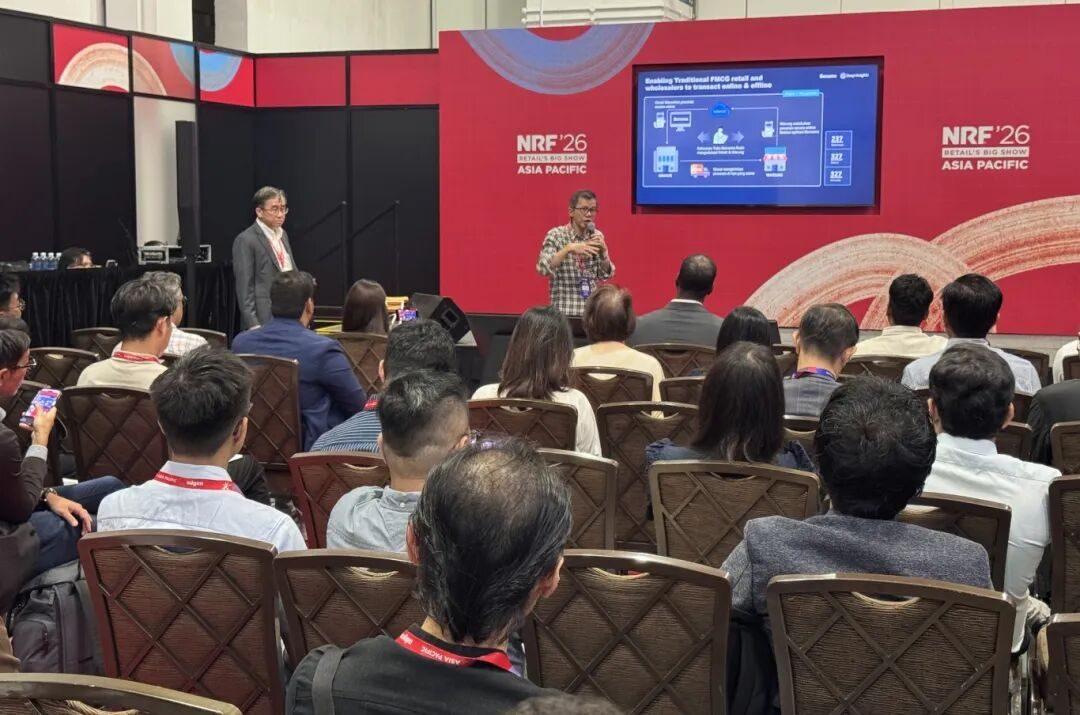
NRF Retail's Big Show Asia Pacific took place in Singapore from June 2–4, 2026, drawing more than 13,000 professionals from over 70 countries.
Deep Insights was invited to the exhibitor innovation sessions. It presented on stage with Indivara Group, a leading Indonesian retail technology group, under the title "From Automation to Autonomy: A Retail Supply Chain's AI Transformation at Scale." Here is a summary.
01. A problem many retailers recognize
The talk opened with a familiar puzzle: we have automated everything we can, so why is our supply chain still falling short?
Three numbers point to the cause. Many retailers run five or more disconnected supply chain systems. Even with WMS, TMS and OMS in place, 72% of exceptions are still handled by phone and messaging apps. The gains from automation have levelled off and are slowly fading. Deep Insights calls this the supply chain efficiency paradox.
02. Traditional retail in Indonesia
Indivara Group CTO Antonius Kho showed what this paradox looks like in an emerging market.
Traditional retail makes up 98.5% of Indonesia's retail outlets and handles more than USD 90 billion in yearly sales, yet it has long been outside the digital economy. Indivara's Bersama platform was built to change that. Its mobile app lets small shops order online and connects them with wholesalers for same-day delivery, bringing traditional retailers into the modern FMCG supply chain.
Bersama now covers more than 50 cities, with over 32,600 active outlets and 472 active wholesalers. As it grew, its supply chain became more complex, which is why Bersama turned to Deep Insights.
03. When a retail network meets an AI supply chain
Philip Leong, Head of International Business at Deep Insights, presented the end-to-end supply chain cloud the two companies built together.
Built on Bersama's retail network, with Deep Insights providing the execution technology, it covers order management (OMS), warehouse execution (WMS/WES) and transport and yard management (TMS/YMS), linking every step from order to delivery. Warehouse agents, transport agents and a control tower let the system make as many decisions on its own as possible across the chain.
04. What actually changes
Traditional automation has clear limits: it runs preset tasks, optimizes one system at a time, reacts after the fact and relies on people to handle exceptions.
AI agents work differently. They are driven by goals, work across systems, deal with exceptions in real time and keep improving. Deep Insights sums this up as a loop: Sense → Decide → Act → Self-heal.
There are two ways to deploy:
- Human–AI collaboration: agents help people decide, and people keep approval rights.
- Multi-agent orchestration: a lead agent breaks down the task and coordinates sub-agents. This suits operations aiming for a high level of automation.
These are not competing options. Companies choose based on how mature their operations are.
05. Specialist agents across the supply chain
Behind this is DI.AI Platform, built over 22 years of serving more than 600 customers. It now runs dozens of specialist AI agents across warehousing, transport, freight forwarding, shipping and general tasks. The talk featured six agents that tackle frequent pain points:
Warehousing
- Replenishment Agent: creates buffer purchase orders and replenishment plans, saving 20–35% of labor and cutting stock waiting time by 50%.
- Inbound Planning Agent: reads arrival windows, schedules dock doors and sends real-time exception alerts. Expected results: 50% less inbound waiting and about 60% higher dock utilization.
- ABC Diagnosis Agent: keeps SKU value classes up to date, flags slow-moving and overstock risks and creates optimization advice in one click. Expected result: about 30% higher inventory turnover.
Transport
- Smart Loading Agent: creates load plans and releases outbound orders. New staff get up to speed in about two days instead of two weeks, and shipping efficiency rises 30–50%.
- Freight Diagnosis Agent: spots cost anomalies in real time and writes root-cause reports. Response time drops from 24 hours to real time, and losses from exceptions fall about 80%.
- Rate Negotiation Agent: negotiates rates across systems and writes the results back into contracts. Tender cycles become much shorter, with reconciliation efficiency expected to improve 95%.
Actual results vary by business scenario.
06. Chinese supply chain AI is already running overseas
This appearance at NRF APAC was a product showcase. It also showed retailers worldwide that Chinese supply chain AI is already running deep inside overseas markets.
> "AI gives us more than visibility. It gives us the power to decide. Making AI agents true core members of the supply chain team is what Deep Insights is doing, and it is how we create value for customers around the world."