> "A medium-sized supply chain disruption costs a company 1%–4.5% of annual revenue on average. By 2026, 40% of enterprise applications will include task-specific AI agents." — Gartner
Over the past year, "agent" has been one of the most-used words in supply chain. But few vendors have taken agents out of slide decks and demos and put them to work in customers' warehouses, fleets and customs brokerages.
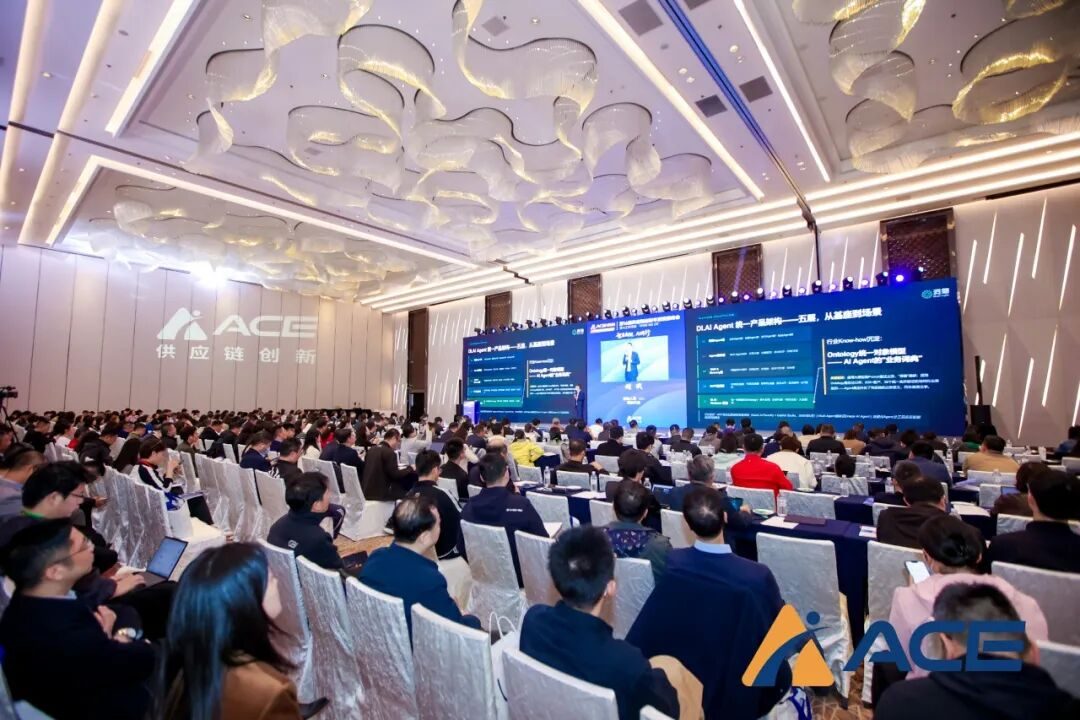
At Deep Insights, we took a fresh look at what we have built over 22 years: industry know-how, 55+ industry modules, 90+ business scenarios, and the 46 specialist AI agents now serving customers at scale. Below is a summary of CEO Bin Liu's keynote at ACE 2026, the 16th Supply Chain Innovation Summit.
Why supply chain execution is stuck
Four problems are holding back supply chain execution in China today:
- Labor limits. Warehouse staff are hard to hire and dispatchers are hard to keep. Labor costs rise by more than 10% a year, and experience cannot be copied quickly. When a senior dispatcher leaves, six months of disruption is almost certain.
- Data silos. WMS, TMS, ERP and OA run side by side, and people cross-check their data by hand in Excel. One error at one step affects the whole chain.
- Reacting too late. Most supply chain teams only find problems after they happen, yet every hour of delay costs customer goodwill and real money.
- Limits to optimization. Even the most experienced people have limits. Faced with huge, complex datasets, no one can spot every chance to cut costs.
These four problems match the four things AI agents do best: repetitive work, coordination across systems, real-time monitoring and finding patterns in huge amounts of data. That is why we chose AI agents as Deep Insights' core product for the next decade.
How we see agents (1): four technical questions
Talk about agents in the market often mixes different things together. We split the technical side into four separate but related questions.
01 Agents used by people: human–AI collaboration
A human-in-the-loop model in which the agent acts as an expert assistant. It takes over low-value, repetitive work, but people keep the right to decide, confirm and sign off. Examples: suggested load plans for dispatchers, recommended quotes and risk alerts for customer service, charts and insights for managers. It solves efficiency.
02 Agents used by agents: agent autonomy
This is what separates toys from real productivity. When a task needs many skills, many systems and many steps, a lead agent breaks it down and coordinates sub-agents that talk to each other in a structured way. For example, a warehouse agent calls a cycle-count agent, a capacity-analysis agent and a relocation agent, then reports the results to operations. It solves autonomy. People only set the goal and the limits.
03 Adding agents to existing systems
This is the most overlooked and most undervalued area. Most companies cannot rip out their WMS, TMS or ERP tomorrow. Through the MCP standard, we let agents use existing systems the way a new employee would, without changing how those systems are built. They can check stock, create shipments, update statuses and issue instructions. The customer's WMS is the same WMS, but it now has a thinking add-on. It solves the problem of existing systems.
04 Agent-native software
Software built from scratch for agents. Object models, permissions, audit logs and exception handling are all designed around agents working inside it. DI.AI Platform is our foundation of this kind: an operating system for a team of AI workers. It solves for the future.
A mature enterprise AI strategy runs all four paths at once. Human–AI collaboration brings quick wins. Agent autonomy takes on complex scenarios. Agent add-ons make existing systems more useful. Agent-native software prepares for the long term.
How we see agents (2): real deployments are the real advantage
A general-purpose model plus a few prompts cannot handle real supply chain operations. Many so-called industry agents are just a model behind a chat box. They look impressive in a proof of concept but break down in real operations: they do not understand WMS, TMS, forwarding or shipping logic, they cannot connect to internal systems, and they cannot guarantee SLAs or compliance. The result is many pilots and few real deployments.
Our 46 agents grew from 22 years of industry data and processes, built on four things:
- Industry know-how built in: 55+ modules and 90+ scenario maps captured in a unified Ontology model.
- Standard MCP connections: WMS, TMS, ERP, customs APIs, carrier APIs and IoT gateways connected through standard protocols, not rebuilt for each customer.
- Bounded Autonomy: agents act within clear business limits. Anything outside those limits goes to a person, and every action can be audited.
- Specialist agents for each scenario: warehouse, transport, forwarding, shipping, customs and commercial agents each handle their own work, like a real team.
Real examples
- Capacity Analysis Agent: storage utilization +20–35%, overflow risk −40%, capacity alerts move from next day (T+1) to real time.
- Inbound Planning Agent: inbound waiting −50%, dock utilization +60%, plans scheduled automatically around the clock.
- ABC Diagnosis Agent: turnover +30%, inventory holding cost −25%.
- Smart Loading Agent: picking efficiency +30–50%, new-staff training cut from 2 weeks to 2 days.
Together these results add up to 50%+ less repetitive work, 95%+ faster processes, 99%+ SLA attainment and 80%+ lower losses from exceptions.
The future of software has no screens: the Rate Negotiation Agent
The biggest change agents bring is not smarter software. It is that the idea of "software" itself starts to fade.
A typical full-truckload tender used to look like this: export historical rates from the TMS, email twenty carriers, compile quotes in Excel, start an approval in OA, then go back to the TMS to enter the new contract. A medium-sized tender kept 2–4 people busy for more than two weeks.
With the Rate Negotiation Agent, the process becomes one instruction: "Launch the annual tender for lane XX, target 5% savings, deadline next Friday." The agent pulls data from the TMS, contract system, email and OA. It negotiates with carriers over several rounds using preset strategies, writes the results back into contracts, starts approvals by rule, and passes exceptions to a person.
The operator never opens a single software screen, only a conversation with the agent. Results: 95%+ faster reconciliation, 80% lower losses from exceptions, round-the-clock unattended operation, and 2–4 full-time staff freed each month.
This shows what the next generation of supply chain software looks like:
- From screens to conversation: people drive systems by stating what they want.
- From processes to goals: people set the goal and the limits, not every step.
- From systems to workers: what used to be a piece of software becomes a digital worker you can "hire".
That is why we call our product AI digital workers, not AI features or modules.
Closing thoughts
We have not simply wrapped a general-purpose model and sold it on. We have used 22 years of industry data to build AI that truly understands supply chains. With DI.AI Platform as the foundation and AI agents doing the work, Deep Insights covers warehousing, transport, freight forwarding and shipping, giving every step of the supply chain a Sense → Decide → Act → Self-heal loop.