By Wang Huimin, China Shipping Weekly
Global shipping faces frequent tariff changes, stricter environmental rules and growing supply chain uncertainty. Controlling costs and improving vessel operations has become a matter of survival for carriers.
Shipping involves a long chain and dozens of types of parties: shippers, forwarders, carriers, agents, ports, customs, warehouses and inland transport. Each has its own data systems. This leads to scattered data, low efficiency, rising costs and risks that are hard to control. Digital technology driven by AI is giving the industry new ways to break through.
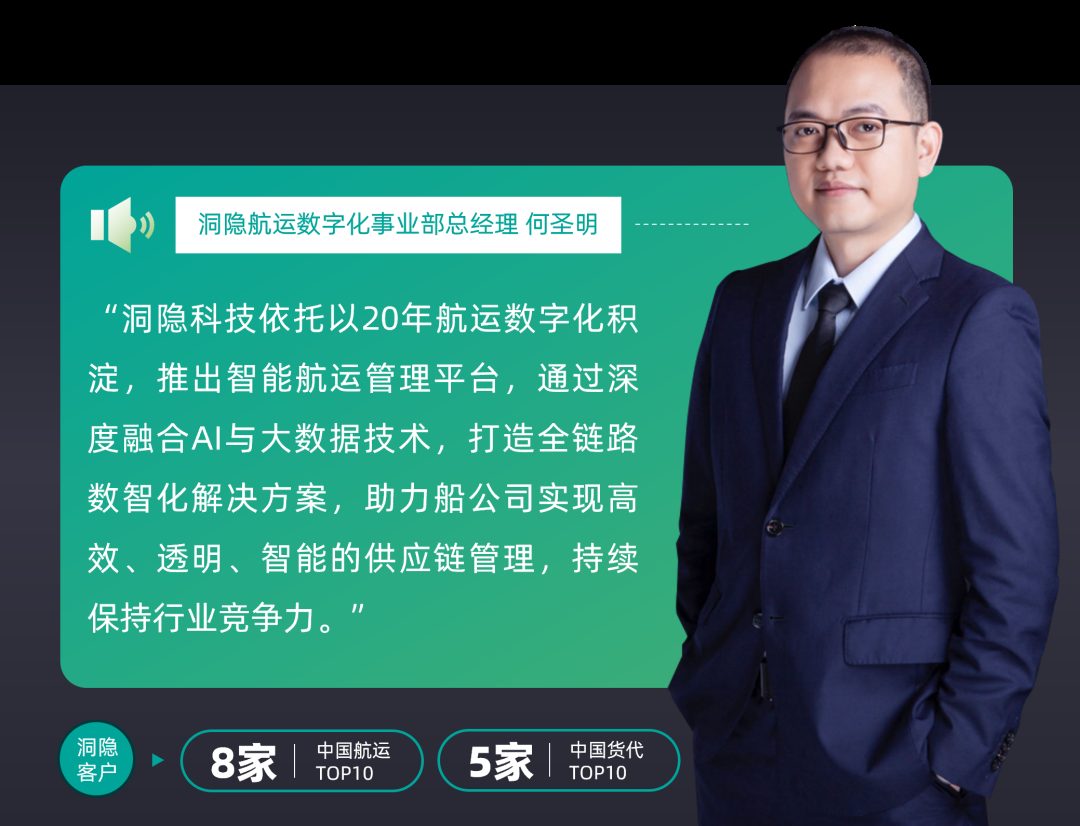
Deep Insights (Xiamen Deep Insights Cloud Chain Technology Co., Ltd.) builds on its SaaS products and combines AI with big data to help carriers digitize and modernize. He Shengming, General Manager of Deep Insights' shipping digitalization division, spoke to China Shipping Weekly.
01 Building a more resilient supply chain
Deep Insights' Smart Shipping Management Platform offers a complete digital and smart upgrade for container carriers, whether they are start-ups, in transition or well established. It covers booking, stuffing, transport and delivery, joining up the whole chain digitally and supporting smart decisions.
Its supply chain visibility platform connects data from more than 150 ports, 300 terminals and 600 container yards worldwide. It shows container status and location in real time, so the whole journey is visible. By combining sea, air, rail and road data, it tracks cargo from origin to delivery, so carriers can spot and deal with risks early.
For efficiency, Deep Insights helps carriers quickly set up a one-stop customer service portal in place of slow, manual booking checks. It also uses automation rules for key container logistics steps to make complex processes simpler.
For cost and risk, built-in AI tools include:
- AI-assisted route optimization: weighs bunker prices, weather and port congestion to estimate cost and transit time and suggest the best routes.
- AI-driven container repositioning: forecasts trade flows and container demand at each port to reduce empty containers left sitting.
- AI-assisted dangerous goods approval: reads dangerous goods information, parses documents, checks compliance across countries and produces risk assessments and approval advice.
02 Smarter decisions
The real turning point in digitalization is not going live. It is when the data can do the thinking. Deep Insights helps carriers make three steps: business online → operations automated → decisions intelligent.
He Shengming explained: "Success depends on three things. First, joining up data across shippers, forwarders, carriers, ports, customs and inland transport. Second, making digital tools work in specific, real situations. Third, building in AI. With our automation rules engine plus AI, the rules engine handles about 80% of the uncontrollable factors and manual work in daily operations, and AI handles the remaining 20% of complex problems."
Deep Insights' smart route planning combines freight rates, weather, port congestion, transit times and costs to quickly show the best route options, with side-by-side comparisons, so carriers can ask the data instead of guessing.
03 Focusing on the key points in shipping
Deep Insights puts AI at the points in the shipping chain where everything else depends on it:
- Smart customer service: available around the clock and already working well at several carriers.
- AI container repositioning: widely used for planning empty containers.
- Dangerous goods approval assistant: especially popular with small and mid-sized carriers.
"The key is turning senior shipping experts' experience into standard capabilities that can be repeated," He said. For large carriers, risk control has long relied on experts whose knowledge leaves when they do. Deep Insights has built a knowledge base from global dangerous goods regulations, accident reports and compliance data, so AI can read DG information, assess risk, check compliance and recommend approvals. Smaller carriers that once avoided dangerous cargo can now make expert-level risk judgments.
Looking ahead, He expects AI to speed up the shift to smarter customer service within months. AI tools already collect customer profiles, cargo needs (such as temperature, humidity and transit time), loading locations and container preferences. They use this to offer tailored services such as shock protection and temperature monitoring for fruit and high-end electronics, or fewer transshipments and direct services for fresh produce.