Deep Insights has signed an agreement with Guangjin Logistics to build AI digital workers (AI agents) deep into its transport management system (TMS). They will cover key tasks including order pre-processing, load planning, freight-rate review and delivery receipt review.
It is the logistics industry's first TMS project to embed AI agents across daily operations. It shows that the shift from systems that support people to AI and people deciding together has arrived in logistics.
01 The AI agent moment for logistics has arrived
Since 2025, large AI models have spread quickly into business software worldwide. "AI agents" are changing how enterprise software works and what it can do. Yet in logistics, an industry built on close control of processes and teamwork between many roles, few projects have made AI a core part of the work rather than a nice-to-have.
A traditional TMS is good at capturing information, moving tasks along and making decisions with fixed rules. It struggles with complex load planning, changing cost analysis, unstructured data and multi-factor review. That is where AI digital workers come in.
02 The first deployment: AI digital workers × Guangjin Logistics TMS
Guangjin Logistics is a third-party logistics provider that delivers personal-care and household brands across China, serving factories, distributors, retailers and e-commerce customers.
The key breakthrough is that the AI digital worker is not a smart plug-in bolted on from outside. It is a digital colleague built into the TMS's core processes. Instead of working through order lists, staff simply talk to it in plain language, which changes how logistics teams work every day.
The AI agents will work in four core scenarios:
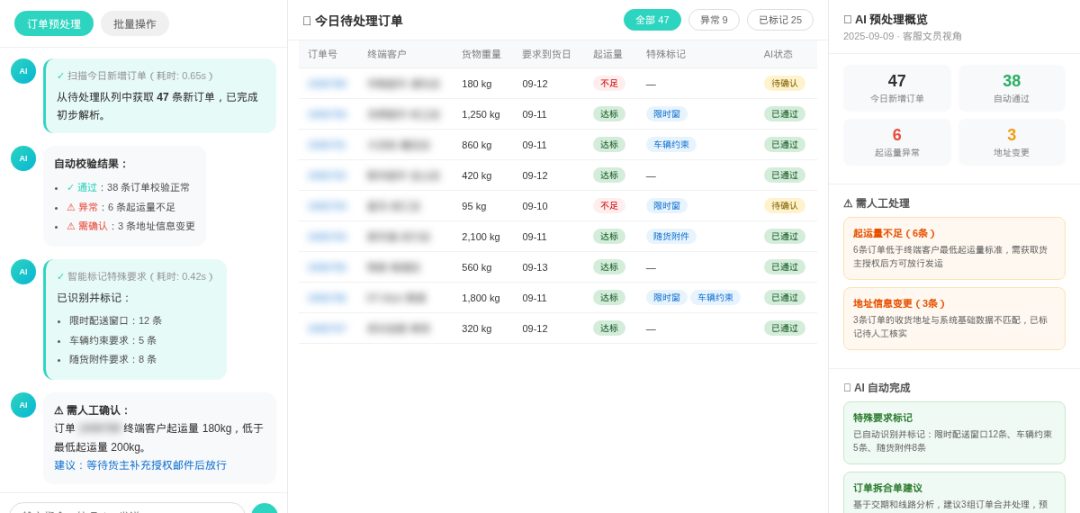
- Order pre-processing: finds order exceptions, checks minimum shipment volumes and flags special requirements, cutting repetitive work for customer service staff.
- Load planning: uses past data and live constraints to create the best truck plans, including combined orders and pickups from several warehouses.
- Freight-rate review: compares prices with past deals, budget baselines and market swings, giving dispatch managers solid grounds for decisions.
- Delivery receipt review: reads delivery receipts, matches them to the right orders and shipments, files them and starts settlement.
Every scenario uses the same three-panel layout: AI chat on the left, the business view in the middle and a smart panel on the right.
03 Why a "digital worker" and not a "smart tool"
We chose the term digital worker on purpose. It stands for a new way for people and AI to work together. A traditional tool waits for the user to click buttons, fill in forms and read reports. A digital worker takes the lead. It understands context, analyzes data, highlights what matters, filters out noise and works with staff through conversation.
For Guangjin's customer service, dispatch and finance teams, this means they no longer have to hunt through long order lists, rely only on gut feeling for load planning, or match receipts to orders by hand. They can focus on exceptions and decisions.
04 Why now
Logistics is at a key moment in its digital shift. Shippers expect more digital capability from their logistics partners, and real-time tracking and smart risk control are now basic requirements. In fast-moving consumer goods, tough competition is pushing pressure onto logistics, so cutting costs and working smarter is now about survival. Logistics companies that build AI into daily operations first will gain a clear edge in response speed, cost control and customer experience.
05 Putting AI agents to work
Deep Insights believes AI's value lies not in impressive technology but in fitting into real processes, solving real problems and helping frontline staff in ways they can feel. This project is the first large-scale rollout of our AI digital worker approach:
- AI built into standard TMS functions, not a separate assistant;
- Different support for each role: customer service, dispatch, finance, risk control and on-site staff;
- Plain-language conversation instead of list screens, for a far better user experience.
Starting with this project, Deep Insights will keep expanding AI in logistics and work with industry partners on new ways for people and AI to work together.