Competition in enterprise AI agents is moving away from demos of general skills and into real, core business work.
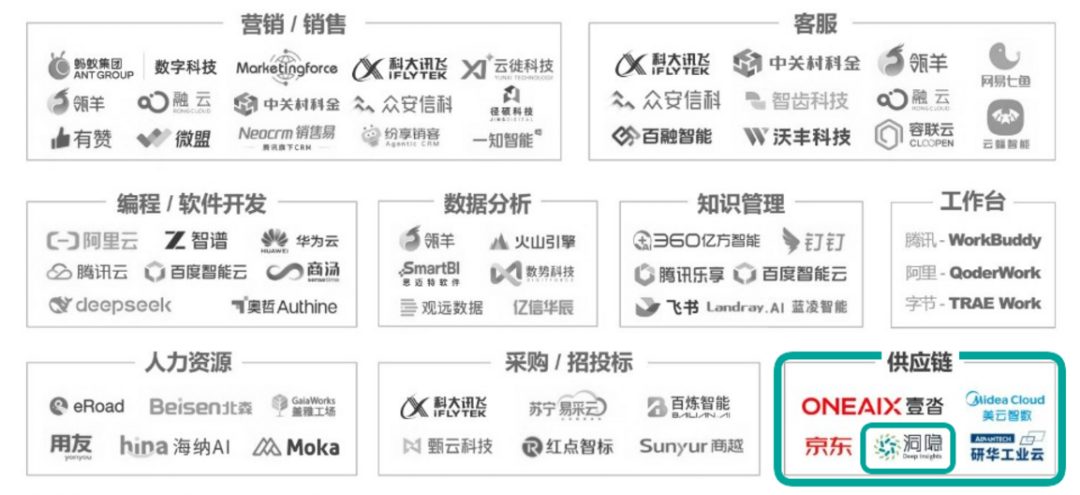
In July 2026, iResearch published its China Enterprise AI Agent Development Insight Report (2026) and its Tech Vendor Map: 2026 China Enterprise AI Agent Vendors. Deep Insights is listed in the Agent Applications – Supply Chain category, alongside JD, Meicloud, Yida Technology and Advantech Industrial Cloud. (The map is not a ranking.)
Enterprises need more than an AI that can chat
iResearch estimates that Chinese enterprises invested about RMB 5.59 billion in agent development platforms, agent applications and AI-enhanced solutions in 2025. It expects this to reach RMB 81.51 billion by 2030, a compound annual growth rate of about 70.9%.
The report finds that about 83.7% of agent projects today handle general tasks such as Q&A and copywriting. Only about 16.3% reach deep into core business processes. When enterprises buy agents, their top concern is the ability to solve complex, specialized business problems (83.7%). Next come data security and operational risk control (79.7%) and proven cases from the same industry (47.7%).
In other words, enterprises no longer just ask whether AI can answer questions. They ask whether it can understand the business, connect to their systems, follow the rules to finish a task, and keep the process controlled and auditable.
iResearch sets out four baseline qualities of a trustworthy AI agent: secure and controllable, specialized and reliable, able to improve over time, and measurable in value. It expects trustworthy agents to grow from 19% of the market in 2027 to 80% by 2030.
Why supply chain needs specialized agents
In iResearch's maturity analysis, supply chain optimization agents are still at an early, experimental stage. Far fewer companies invest in them than in coding, customer service or marketing agents.
The reason is not a lack of things to improve. Supply chain work is rarely a single, stand-alone task. One document, one stock movement, one shipment or one customs filing usually involves several systems, several parties and many industry rules. An AI has to understand the problem, identify the business objects involved, call the right systems, and act within its permissions and the rules. A general-purpose large model alone can hardly do this.
Deep Insights has worked in supply chain and logistics software for more than 20 years and serves over 600 enterprise customers. Its cloud products cover orders, transport, warehousing and freight forwarding. That experience gives its AI agents real business scenarios, industry rules and working systems to build on.
So Deep Insights does not see a supply chain AI agent as a replacement for existing systems. It sees it as a digital worker that runs on top of them: one that understands business objects, follows operating rules and completes tasks on its own within the limits people authorize.
From a unified platform to digital workers in the flow of work
To move agents from single features into real operations, Deep Insights built DI.AI Platform. It brings supply chain object semantics (Ontology), system connections (MCP), skills and memory, multi-agent orchestration, and governance and auditing into one foundation. Agents for different scenarios can then be reused, governed and audited, instead of living as separate chatbots.
Delivery receipt review: 8 checks in 5–6 seconds
The digital worker POD Checker automatically checks eight items: order number, stamp, signature, quantity, date, licence plate and container number, and more. It returns three verdicts in 5–6 seconds.
At a salt industry group handling about 1,500 receipts a day (around 600,000 a year), the field-level error rate is about 0.1‰. Average review time per receipt has fallen from about 10 minutes to 1.5 minutes. AI handles about 95% of routine reviews, and people focus on the remaining 5% of exceptions. A global food and beverage company is also rolling it out.
Warehouse optimization: three agents working together
At a warehouse for a global consumer electronics company, Deep Insights runs three coordinated agents on one shared rules center: putaway, replenishment and consolidation. The AI recommends storage locations in seconds, triggers replenishment from orders, and scans the warehouse on a schedule to suggest consolidation moves. The goal is to raise storage utilization from 60% to over 90%.
The project is delivered in stages: shadow mode, then parallel validation, then controlled go-live. Every AI recommendation can be explained and audited.
Both use cases follow the same principles. There is a clear line between what a digital worker may do on its own and what a person must confirm. Low-confidence results or actions beyond its permissions are automatically passed to a person. Every step leaves a full audit trail.
That is how Deep Insights understands a trustworthy AI agent: acting on its own does not mean acting without human oversight. It means AI takes on real work within clear limits.
From insights to autonomy
iResearch expects the enterprise AI agent market to enter a phase of fast, practical adoption from 2027. Vendors with industry knowledge and business experience will have the edge in specialized use cases.
Deep Insights will keep following its Platform + AI Workers approach in supply chain and logistics. The aim is for AI to do more than offer insights and suggestions: under human oversight, it will take over complete, verifiable pieces of work.